

The journey
Overview
Traversing Japan by Bullet Train, from Osaka to Kyoto, Hakone and Tokyo, this small-group tour takes in neon-lit cityscapes, geisha lanes, Shinto shrines and views of Mount Fuji. It reveals a country where
timeless tradition sits comfortably alongside contemporary life.
This 10-day small-group tour follows the bullet-train route from Osaka to Tokyo, connecting Japan’s most rewarding cities. We begin with Osaka’s street food and castle, then settle into Kyoto for three nights of temples, tea ceremonies and bamboo groves. A day on Miyajima Island and a morning at Hiroshima’s Peace Memorial Park precede the hot springs and volcanic scenery of Hakone, with views of Mount Fuji. We finish in Tokyo, where morning incense at Meiji Jingu gives way to the buzz of Shibuya and Shinjuku by afternoon.
Unforgettable moments
Highlights
01
Kyoto
Three nights of golden temples, Zen gardens, bamboo groves, a tea ceremony and the lantern-lit lanes of Gion
02
Hiroshima and Miyajima Island
Visit the Peace Memorial Park and take the ferry to Itsukushima Shrine’s floating torii gate
03
Hakone and Mount Fuji
Cruise Lake Ashi, ride the ropeway over volcanic Owakudani and look for Fuji on the horizon
04
Tokyo
From the forest calm of Meiji Jingu to the neon rush of Shibuya Crossing, all in a single day
Your itinerary
Day by day
- Day1
Arrive Osaka. Umeda Sky Building+
Your tour begins in Osaka, Japan’s second city – unpretentious, energetic and obsessed with good food.
You should be aware that this is a busy itinerary with some full days and morning departures. Sightseeing can involve a good amount of walking on uneven surfaces and the use of public transport. Please note that in Japan room sizes are generally smaller than in Europe and double beds are not available at all hotels.
At 2pm, we head to the Umeda Sky Building. Two 40-storey towers are joined at the top by the Floating Garden Observatory, an open-air circular deck reached by glass-enclosed escalators that cross a wide central atrium. As we step out onto the rooftop, Osaka spreads in every direction. Gaze at a sea of concrete and neon, rivers threading through the grid, and mountains faintly visible beyond. Designed by architect Hiroshi Hara (who also created Kyoto Station), the building is a striking way to get your bearings.
StayOsaka Excel Tokyo Hotel (or similar 4-star) - Day2
Osaka Castle and Dotonbori. Travel to Kyoto for Gion+
This morning, we visit Osaka Castle, the city’s most recognisable landmark. First built in 1583 under Toyotomi Hideyoshi, the castle has been destroyed and rebuilt several times, with the current structure dating from 1931. Surrounded by moats and formidable stone walls, it tells Osaka’s story in broad strokes, with a museum inside and wide views from the observation deck.
From here, we walk into the neon glow and sizzle of Dotonbori, one of Osaka’s liveliest districts. Giant mechanical signs loom overhead, restaurant touts call from every doorway, and the air is thick with the smell of cooking. We sit down for okonomiyaki, the savoury cabbage pancake that Osaka claims as its own. It arrives at the table still bubbling on the hotplate, topped with rich sauce and mayonnaise.
In the afternoon, we travel to Kyoto and step into the atmospheric streets of Gion, the city’s celebrated geisha district. We follow the quiet Shirakawa canal, lined with traditional wooden houses, then walk along Hanamikoji Street past long-established tea houses and restaurants where customs have barely changed in generations. As we move through the district, we may be lucky to catch a glimpse of geisha or maiko making their way between engagements, wooden sandals clicking on the stone. We finish at Yasaka Shrine, with views across the surrounding traditional streets.
StayRihga Gran Hotel (or similar 3-star)MealsBreakfast, Lunch - Day3
Golden Pavilion, Ryoan-ji rock garden and Arashiyama+
We start the day at Kinkaku-ji, the Golden Pavilion. Covered in gold leaf and reflected in the surrounding pond, the temple is a textbook example of Muromachi-period architecture. The light shifts constantly here. On a still morning, the reflection in the pond is almost perfect, doubling the gold against the dark water.
Next is Ryoan-ji Temple and its famous dry rock garden. Fifteen stones sit across raked white gravel, a composition that has prompted centuries of interpretation. We sit on the wooden veranda and take it in.
We then head to Arashiyama on the western edge of Kyoto. The path through the Bamboo Grove is the highlight. Towering stalks form a shaded corridor, their leaves rustling and creaking overhead as they sway in the breeze – where the light filters through in green shafts. The path leads us to Tenryu-ji, a UNESCO World Heritage Site and one of Kyoto’s principal Zen temples. The garden is designed to borrow the surrounding hills as part of its layout, with a pond and pathways that feel both considered and completely natural.
StayRihga Gran Hotel (or similar 3-star)MealsBreakfast - Day4
Kiyomizu-dera, tea ceremony and Zen meditation. Afternoon free+
After breakfast, we walk towards Kiyomizu-dera Temple along a traditional Kyoto street lined with small shops and craft stalls selling ceramics and souvenirs. At the temple grounds, we take in the painted pagoda and the wooden stage, built without a single nail using traditional joinery. From the terrace, the city and its surrounding hills spread out below us, a patchwork of grey tile, green canopy and distant mountains.
From here, we continue on foot through the Higashiyama district. The lanes of Ninen-zaka and Sannen-zaka climb gently between pottery studios, small eateries and clusters of shops. The pace is slow, the buildings are beautifully preserved, and there’s something around every corner.
Our morning finishes with a Japanese tea ceremony. Guided by a tea master, we learn the careful, deliberate movements behind the preparation of matcha: the whisking, the turning of the bowl, the quiet that settles around the ritual. We follow this with a short Zen meditation led by a Buddhist monk.
The afternoon is yours in Kyoto. Return to Higashiyama, find a riverside café, or seek out one of the smaller neighbourhood shrines.
StayRihga Gran Hotel (or similar 3-star)MealsBreakfast - Day5
Bullet train to Hiroshima. Miyajima Island+
We travel by bullet train to Hiroshima, then continue to Miyajimaguchi Port for the ferry to Miyajima, a small island in the Seto Inland Sea with a long spiritual history. Deer roam freely here, nosing around visitors with complete confidence, and the wooded slopes rise steeply from the shore.
Our visit starts at Itsukushima Shrine, an important Shinto site dating back to the 6th century. Built on stilts above the water, the shrine’s vermillion o-torii gate appears to float at high tide, the sea filling in around it while its reflection wavers below. From here, we climb towards Daishoin, one of the island’s major Buddhist temples, up a staircase lined with spinning prayer wheels that visitors turn as they pass.
Afterwards, there’s time to explore at your own pace. The island’s food is worth seeking out: oysters grilled over charcoal at waterfront stalls, saltwater eel glazed and served on rice, and momiji manju, the maple-leaf-shaped cakes filled with red bean, custard or chocolate that you’ll see everywhere.
We return by ferry to the mainland. Main luggage is transferred separately to Hakone, so please carry an overnight bag.
StayHotel Granvia (or similar 3-star)MealsBreakfast - Day6
Hiroshima Peace Memorial Park. Bullet train to Hakone+
Our morning is spent at Hiroshima Peace Memorial Park, created on the ground that lay at the centre of the 1945 atomic bombing. We walk through the park to the A-Bomb Dome (Genbaku Dome), the preserved shell of the former Industrial Promotion Hall, then pause at the Children’s Peace Monument, where thousands of paper cranes are displayed, each one folded with care and meaning.
Inside the Peace Memorial Museum, the East Wing traces the city’s history and its work towards peace. The West Wing displays personal belongings and materials from 1945. It is a quietly powerful place, and one that deserves quiet contemplation.
We transfer to Hiroshima Station, with time to pick up a bento box for the journey, and board the bullet train for Odawara (approx. four hours), continuing by coach to Hakone.
After checking in, the hotel’s hot spring baths are waiting – steaming outdoor pools surrounded by forest and cool mountain air. Our rooms are traditional Japanese style, with tatami floors, low furnishings and futon bedding. This evening, we sit down to a kaiseki dinner: a sequence of small, seasonal courses, each one arranged with the kind of precision that makes you pause before picking up your chopsticks. Clear soup, sashimi, grilled fish, pickled vegetables, rice, miso, and something sweet to finish.
StayYunohana Prince Hotel (or similar 4-star)MealsBreakfast, Dinner - Day7
Hakone, Lake Ashi and onwards to Tokyo+
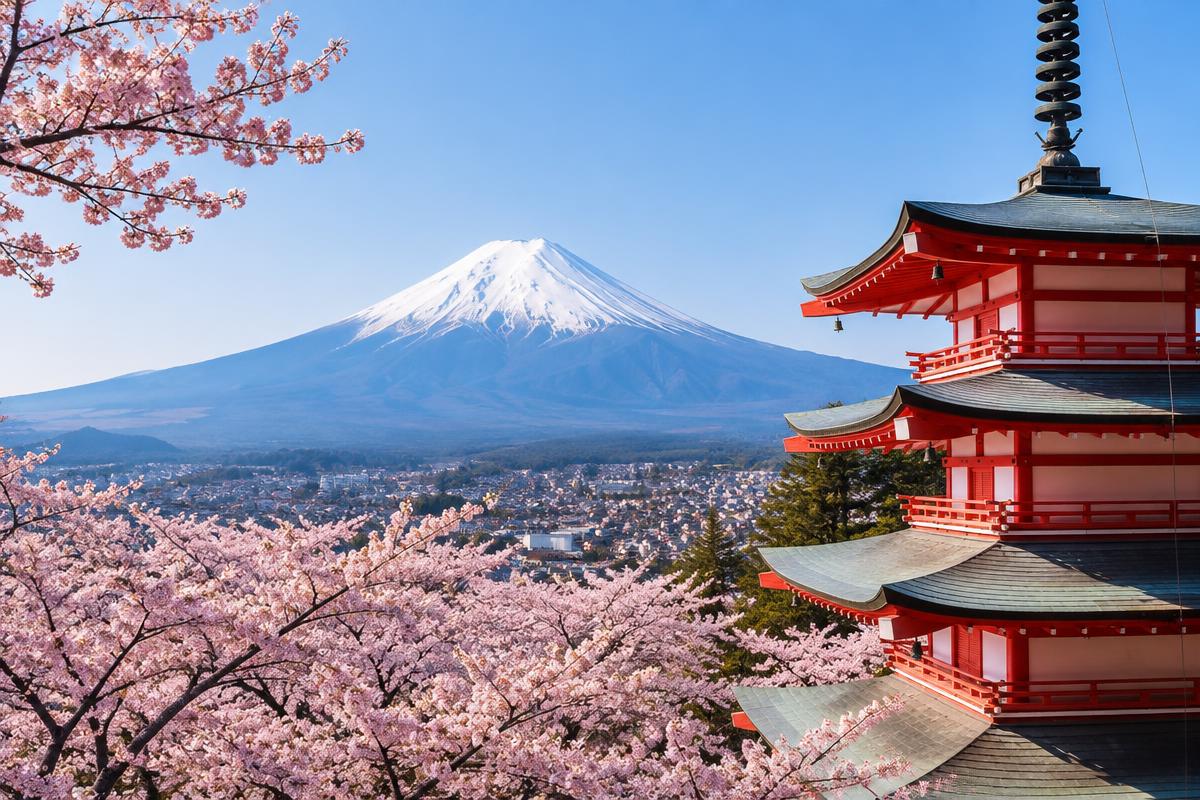
We drive to Owakudani, a volcanic valley where steam vents hiss from cracks in the rugged terrain and the air carries a faint whiff of sulphur. The landscape is raw and lunar. On clear days, Mount Fuji is visible in the distance, its snow-capped symmetry rising above everything else.
From here, we ride the Hakone Ropeway over the valley towards Sōzan Station. Next is Hakone Shrine, set among forested slopes with its well-known vermillion torii gate standing at the lake’s edge. We walk a preserved section of the Tokaido trail, the historic route that once linked Edo (modern Tokyo) and Kyoto, then board a boat for a crossing of Lake Ashi. The lake was formed by volcanic activity thousands of years ago, and views of the surrounding hills, and occasionally Fuji, unfold from the water.
In the afternoon, we visit Oishi Park in the Kawaguchi Lake region before continuing to Tokyo. Overall driving time today is around four hours.
StayShiba Park Hotel (or similar 4-star)MealsBreakfast - Day8
Ueno, sushi-making class and Asakusa+
Today, we start in Ueno, a cultural district centred on its spacious park. A walk through the grounds brings us to the Tokyo National Museum, where scrolls, samurai armour, lacquerware and ceramics trace the development of Japanese art across centuries.
Lunch is hands-on, with a sushi-making class at a local restaurant. Guided by an instructor, we learn to shape nigiri, roll maki and press delicate temari sushi, covering rice preparation, fish selection and the surprisingly tricky art of getting the right amount of wasabi. Then we eat what we’ve made.
Our afternoon takes us to Asakusa, one of Tokyo’s oldest districts. We visit Sensō-ji, the city’s oldest Buddhist temple, approaching through the great Kaminarimon Gate and along Nakamise Street, a narrow route lined with shops selling street food, wooden combs, painted fans and every variety of souvenir. On the way back, we make a brief stop at the Imperial Palace Plaza and Nijubashi Bridge, with views across the palace grounds framed by carefully tended pine trees.
StayShiba Park Hotel (or similar 4-star)MealsBreakfast, Lunch - Day9
Enjoy the highlights of the city+
We begin at Meiji Jingu, a Shinto shrine dedicated to Emperor Meiji and Empress Shōken. The surrounding forest, planted by volunteers over a century ago with around 100,000 trees, swallows the noise of the city within a few steps. Gravel crunches underfoot, light filters through the canopy, and it feels a world away from the neon just beyond the gates.
Leaving the shrine, we walk through Harajuku and its Takeshita Street, a compact, colourful alley of boutiques, cafés and independent shops that captures the neighbourhood’s creative energy. By coach, we pass Shibuya Crossing, where pedestrians pour across the intersection from every direction when the lights change, and drive along Omotesando, a broad avenue known for its architectural variety.
In the afternoon, we visit the Tokyo Metropolitan Government Building in Shinjuku, taking the lift to the observation deck for a panoramic view across the city’s sprawl.
This evening, our guide walks us to a traditional izakaya for a farewell dinner. Small shared plates arrive steadily. From grilled skewers, fried tofu, edamame to pickles and slices of sashimi, washed down with sake and cold beer. There's time to swap stories and our favourite moments from the last nine days.
StayShiba Park Hotel (or similar 4-star)MealsBreakfast, Dinner - Day10
Tour ends in Tokyo+
Your tour ends this morning after breakfast.
MealsBreakfast
Accommodation
Where you stay
Osaka
Osaka Excel Hotel Tokyu
Kyoto
Rihga Gran Hotel
Located in Kyoto’s Minami district, this 3 star hotel offers a convenient base with the railway station only a short walk away, providing easy access to local transport, regional trains and the Shinkansen. The area around the hotel features shops and cafés, ideal for relaxed downtime. Facilities include a restaurant, bar, lounge, public bath and free WiFi, while the comfortable air-conditioned rooms offer a hairdryer, safe, mini-fridge, tea/coffee making facilities and TV.
Hiroshima
Hotel Granvia
Directly connected to JR Hiroshima Station, this 3 star hotel offers excellent convenience for exploring the city, with easy access to trams for the Peace Memorial Park and short transfers to Hiroshima Castle. Guests can enjoy a choice of restaurants and free WiFi. Air-conditioned rooms include a hairdryer, safe, mini-fridge, tea/coffee making facilities and TV.
Hiroshima
Hotel Granvia Hiroshima South Gate
Opened in 2025 beside the new Hiroshima Station building, this 4 star hotel offers direct access to transport and an easy base for exploring the city and wider Setouchi region. Its main restaurant focuses on local ingredients and features a live kitchen, while the hotel provides free WiFi and modern guest facilities. The air-conditioned rooms, located on floors 9–21, include a hairdryer, safe, mini-fridge, tea/coffee making facilities and TV for a comfortable stay.
Hakone
Yunohana Prince
This traditional 4 star ryokan style hotel offers an authentic stay with indoor and outdoor hot spring baths and free WiFi. Its Japanese style rooms feature tatami flooring, futon bedding, a hairdryer, safe, mini-fridge, tea/coffee making facilities and TV. The on-site restaurant is serving seasonal Japanese dishes. The hotel’s location provides convenient access to Hakone’s major sights, including Owakudani, the Open Air Museum and JR Odawara Station, all within easy driving distance.
Tokyo
Shiba Park Hotel
Located in Tokyo’s historic Shiba district, this 4 star hotel offers easy access to Zojoji Temple, Shiba Park and nearby city landmarks. Inside, curated books and quiet lounges create a relaxing atmosphere, while the lobby serves wine, craft beer, tea and coffee. Guests can enjoy Japanese, Western and Chinese dishes at The Dining. The hotel provides free WiFi throughout, and its air-conditioned rooms include a hairdryer, safe, mini-fridge, tea/coffee making facilities and TV.
Tokyo
Hotel Monterey Hanzomon
Located just a one minute walk from Hanzomon Subway Station and close to the Imperial Palace, this 4 star hotel offers excellent access to central Tokyo while maintaining a calm atmosphere. Guests can enjoy a daily breakfast in the breakfast room and make use of free WiFi throughout the property. The warmly furnished air-conditioned rooms include a hairdryer, safe, mini-fridge, tea/coffee making facilities and TV. Yasukuni Shrine is within walking distance, and major districts such as Shibuya and Ginza are a short train ride away.
Hotels are as planned; occasionally similar alternatives are used.
Peace of mind
What's included
- ✦9 nights’ accommodation
- ✦Meals Included: breakfast daily, 2 lunches and 2 dinners
- ✦Itinerary as described
- ✦Services of guides and local representative
- ✦Flights from the UK can be added — ask your adviser