
The journey
Overview
This 15-day tour covers more of Turkey than most travellers see in a lifetime. It begins and ends in Istanbul, with time for both the city’s great Byzantine and Ottoman landmarks and a cruise along the Bosphorus. In between, the route heads south to Gallipoli, Troy, Pergamon and Ephesus, then inland to the marble city of Aphrodisias and the mineral terraces of Pamukkale. East from here, we visit the Mevlana Museum in Konya, the rock-carved valleys of Cappadocia, the Hittite capital at Hattusha, the Phrygian tumuli at Gordion and the early Ottoman mosques of Bursa.
Unforgettable moments
Highlights
01
Istanbul
Explore the Hagia Sophia, Topkapi Palace, the Grand Bazaar and a Bosphorus cruise in Turkey’s great crossroads city
02
Ephesus
Walk the marble-paved streets of one of the ancient world’s greatest cities, with its library façade and Roman terraced houses
03
Cappadocia
Discover fairy chimneys, rock-carved churches and an underground city in Göreme’s volcanic landscape
04
Pamukkale
See the mineral-rich hot springs cascading over white limestone terraces above the ruins of ancient Hierapolis
Your itinerary
Day by day
- Day1
Arrive in Istanbul+
Your tour begins in Istanbul, a city built across two continents and shaped by more than two thousand years of empires, trade and reinvention.
Dinner is included at the hotel this evening.
StayElite World Istanbul Taksim (or similar 4-star)MealsDinner - Day2
Dolmabahçe Palace, Yedicule Fortress and a Bosphorus cruise+
Your tour guide will meet everyone over breakfast this morning to outline the days ahead.
We begin at Dolmabahçe Palace, Turkey’s largest palace and the last seat of the Ottoman sultans. Built between 1843 and 1856 by Sultan Abdülmecid I, it stretches along the Bosphorus waterfront in a lavish blend of baroque, rococo and neoclassical styles mixed with Ottoman craftsmanship. The Ceremonial Hall, with its four-and-a-half-tonne Bohemian crystal chandelier, gives a clear sense of the scale the sultan was aiming for.
From here we head to Yedicule, the Fortress of the Seven Towers, at the southern end of Istanbul’s ancient Theodosian Walls. The fortress was built by Sultan Mehmed II in 1457, incorporating the 5th-century Byzantine Golden Gate, once the triumphal entrance to Constantinople. Four of the seven towers are Byzantine, three are Ottoman. The walls and passageways open onto views across the Sea of Marmara.
Later this afternoon we cruise along the Bosphorus, passing waterfront palaces, mosques, Ottoman villas and the wooded hills that line both shores. It’s the best way to see how the European and Asian sides of Istanbul face each other across the strait.
StayElite World Istanbul Taksim (or similar 4-star)MealsBreakfast - Day3
Gallipoli, then across the Dardanelles to Çanakkale+
We leave Istanbul this morning and skirt the Sea of Marmara, heading west toward the Gallipoli peninsula (approx. four and a half hours). The battlefields and memorials of the 1915 ANZAC landings are spread across a landscape of pine forests, ridges and narrow coves. The scale of what happened here only really registers when you stand on the ground and look out over the terrain.
From Gallipoli we cross the Dardanelles by ferry, the narrow strait the ancient Greeks called the Hellespont and one of the most fought-over waterways in history. On the far side, the small port town of Çanakkale has cobbled streets, a seafront promenade, a clocktower and a relaxed atmosphere for somewhere with so much history on its doorstep.
StayKolin Hotel (or similar 4-star)MealsBreakfast, Dinner - Day4
Ancient Troy, the acropolis of Pergamon and on to Kusadasi+
This morning we visit the ruins of ancient Troy, a site that has fascinated travellers for over 3,000 years. Nine cities were built on top of each other here over more than three millennia, and the layered remains are more complex than they first appear. The museum alongside brings the finds to life with artefacts from across Troy’s long history. On the seafront in modern Çanakkale, a large wooden horse marks the legend’s enduring hold on the town.
From Troy we travel south to Bergama and the acropolis of Pergamon, one of the great cities of the ancient Greek world. The site sits high on a hilltop above the modern town, with a steep theatre carved into the hillside, the remains of the Temple of Trajan and sweeping views across the Caicus valley. Pergamon's library was once one of the largest in the ancient world.
We continue south along the Aegean coast to Kusadasi, our base for the next three nights.
StayElite World Kusadasi (or similar 5-star)MealsBreakfast, Lunch, Dinner - Day5
The ancient city of Ephesus+
Ephesus is one of the best-preserved classical cities in the Mediterranean, and today’s visit gives it the time it deserves. We enter along the marble-paved Sacred Way, passing the Odeon, the Temple of Hadrian and the public latrines before reaching the Library of Celsus, its two-storey façade one of the most photographed ancient structures in the world. Beyond it, the 25,000-seat Great Theatre rises up the hillside.
We also visit the Roman Terrace Houses, where well-preserved frescoes, mosaics and underfloor heating systems reveal how the city’s wealthiest residents lived. Nearby, the 6th-century Basilica of St John, built on the hill above Ephesus during the reign of Emperor Justinian, marks what is traditionally believed to be the apostle’s burial site.
Later, we visit a village workshop in Selçuk for a demonstration of silk production and traditional carpet weaving, a chance to see the craftsmanship and materials up close.
StayElite World Kusadasi (or similar 5-star)MealsBreakfast, Dinner - Day6
An organic farm visit and Sirince village. Afternoon at leisure+
A gentler pace this morning. We visit Degirmen Organic Farm and its olive oil museum, where the production process is explained from grove to bottle. From here we continue to Sirince, a hillside village originally settled by Greeks and now known for its stone and whitewashed houses, narrow lanes and fruit wine. The village produces wine from pomegranate, blackberry and peach among others, and a tasting is included.
The afternoon is free in Kusadasi. The marina and Sahil Beach are both close to the hotel, and the waterfront restaurants serve fresh Aegean seafood, grilled simply with olive oil and lemon. Try the midye dolma (stuffed mussels) from one of the street stalls, or walk the causeway to Pigeon Island and its small hilltop castle for views back across the bay.
StayElite World Kusadasi (or similar 5-star)MealsBreakfast, Dinner - Day7
Aphrodisias and the travertine terraces of Pamukkale+
We head inland this morning to Aphrodisias, a UNESCO-listed city named after the goddess of love and one of the finest archaeological sites in western Turkey. The Temple of Aphrodite, dating from the 3rd century BC, was later converted into a Christian basilica, and 14 of its original Ionic columns still stand. The city’s 30,000-seat stadium is one of the best preserved in the ancient world, and the on-site museum displays sculpture from the famous Aphrodisian school, whose marble carvers were sought after across the Roman Empire.
From here we continue to Pamukkale, whose name means ‘cotton castle’ in Turkish. Mineral-rich hot springs cascade over brilliant white limestone terraces, forming shallow pale-blue pools that look almost unreal against the surrounding hillside. Above the terraces sit the ruins of ancient Hierapolis, a Roman spa city whose visitors came for the same thermal waters 2,000 years ago. The necropolis here is one of the largest and best preserved in Anatolia.
StayAdempira Termal and Spa Hotel (or similar 5-star)MealsBreakfast, Dinner - Day8
East to Konya and the Mevlana Museum+
A longer drive today (around six hours) as we travel east across the Anatolian plateau to Konya, the former Seljuk capital and a city deeply connected to the Sufi tradition.
Our main visit is to the Mevlana Museum, the resting place of Jalal ad-Din Muhammad Rumi, the 13th-century poet and mystic whose teachings inspired the Whirling Dervish order. The museum occupies the former dervish lodge and contains Rumi’s tomb beneath a distinctive green-tiled dome that dominates the Konya skyline. Inside, the ornate sarcophagi, manuscripts, prayer rugs and dervish artefacts give a vivid sense of the Sufi traditions that grew up around this site.
We also visit the Karatay Madrasa, a 13th-century Seljuk theological college whose interior dome is covered in blue-and-black Seljuk tilework, and the mosques that surround it.
StayNovotel Konya (or similar 5-star)MealsBreakfast, Lunch, Dinner - Day9
Konya’s Alâeddin Mosque and the Sultanhanı caravanserai. Then Cappadocia+
Before leaving Konya we visit the Alâeddin Mosque, one of the city’s oldest, set on a hilltop park in the centre. From here we travel east toward Cappadocia (approx. three hours), stopping en route at Sultanhanı, where the largest medieval caravanserai (roadside inn) in Turkey stands on the old Silk Road between Konya and Aksaray. Built in 1229 by the Seljuk sultan Alaeddin Keykubad I and extended after a fire in 1278, its monumental carved portal, vaulted halls and raised courtyard mosque are among the finest examples of Seljuk architecture in the country.
Arriving in Cappadocia, we settle into our hotel in the Mustafapaşa area of Ürgüp, a small village with stone houses and a quiet atmosphere. Later this afternoon we visit a pottery workshop in nearby Avanos, where local red clay from the Kızılırmak river has been used by potters for centuries. Watching the process from raw clay to finished piece is a reminder that not everything in Cappadocia is about the landscape.
StayHanedan Cappadocia Suites (or similar 3-star boutique hotel)MealsBreakfast, Dinner - Day10
The Göreme Valley, Uçhisar and the underground city of Kaymakli+
An optional hot-air balloon ride is available this morning (pre-bookable). The balloons lift off at dawn and drift over the fairy chimneys, valleys and rock spires of Cappadocia as the light changes. It’s one of the most popular balloon flights in the world, and you'll soon discover why.
On the ground, we spend the day exploring the Göreme Valley and its surroundings. The valley’s rock-carved churches, many dating from the 10th and 11th centuries, contain Byzantine frescoes that survive in remarkable condition given their age and setting. The formations themselves, shaped by millennia of volcanic activity and erosion, create a landscape unlike anywhere else.
We also visit Uçhisar, a fortress carved from a single rock pinnacle with wide views across the region, and descend into the underground city of Kaymakli, where early Christians carved out a multi-level settlement complete with ventilation shafts, storage rooms and churches, all hidden beneath the Anatolian plain.
An optional Whirling Dervish ceremony at an ancient caravanserai is available this evening (pre-bookable).
StayHanedan Cappadocia Suites (or similar 3-star boutique hotel)MealsBreakfast, Dinner - Day11
The Hittite capital at Hattusha. Then on to Ankara+
We leave Cappadocia this morning and head north to Hattusha, the UNESCO-listed Bronze Age capital of the Hittite Empire. The Hittites controlled much of Anatolia and parts of the ancient Near East from around 1180 BC, rivalling Egypt in power and influence before their empire collapsed.
The ruins are spread across a wide, hilly site. The city walls, originally stretching more than six kilometres, are still traceable across the landscape. The Lion Gate, the King’s Gate and the Sphinx Gate each have carved reliefs that have survived more than 3,000 years. At the Great Temple complex, a large and mysterious polished green stone (possibly nephrite or serpentine) sits among the foundations, its purpose still debated. The open-air rock sanctuary of Yazılıkaya nearby contains processions of gods and goddesses carved into the living rock.
From Hattusha we continue south to Ankara (approx. three hours).
StayRadisson Blu Hotel (or similar 4-star)MealsBreakfast, Dinner - Day12
Museum at Ankara, Anitkabir and the Gordion tumulus. Then Bursa.+
We begin at the Museum of Anatolian Civilisations, set in a restored 15th-century covered bazaar. The collection traces the sweep of Anatolian history from the Palaeolithic to the Ottomans, with exceptional Hittite, Phrygian and Urartian artefacts. The Hittite stone reliefs and bronze figurines are among the finest anywhere.
From here we visit Anitkabir, the mausoleum of Mustafa Kemal Atatürk, founder of the Turkish Republic. The monumental complex crowns a hilltop in central Ankara, approached via a ceremonial avenue lined with stone lions. The site remains a place of deep significance for many Turks and offers a clear view of how modern Turkey sees its own founding story.
In the afternoon we drive to Gordion, capital of the ancient Phrygian kingdom and a UNESCO World Heritage Site since 2023. The Great Tumulus, a vast burial mound dating from around 740 BC, is traditionally associated with King Midas. Recent excavations have uncovered further royal tombs nearby, adding to the picture of Phrygian power and ceremony at this site.
We continue west to Bursa (approx. four hours).
StayMövenpick Bursa (or similar 5-star)MealsBreakfast, Dinner - Day13
Bursa’s mosques, Ottoman tombs and the silk bazaar. Then Istanbul.+
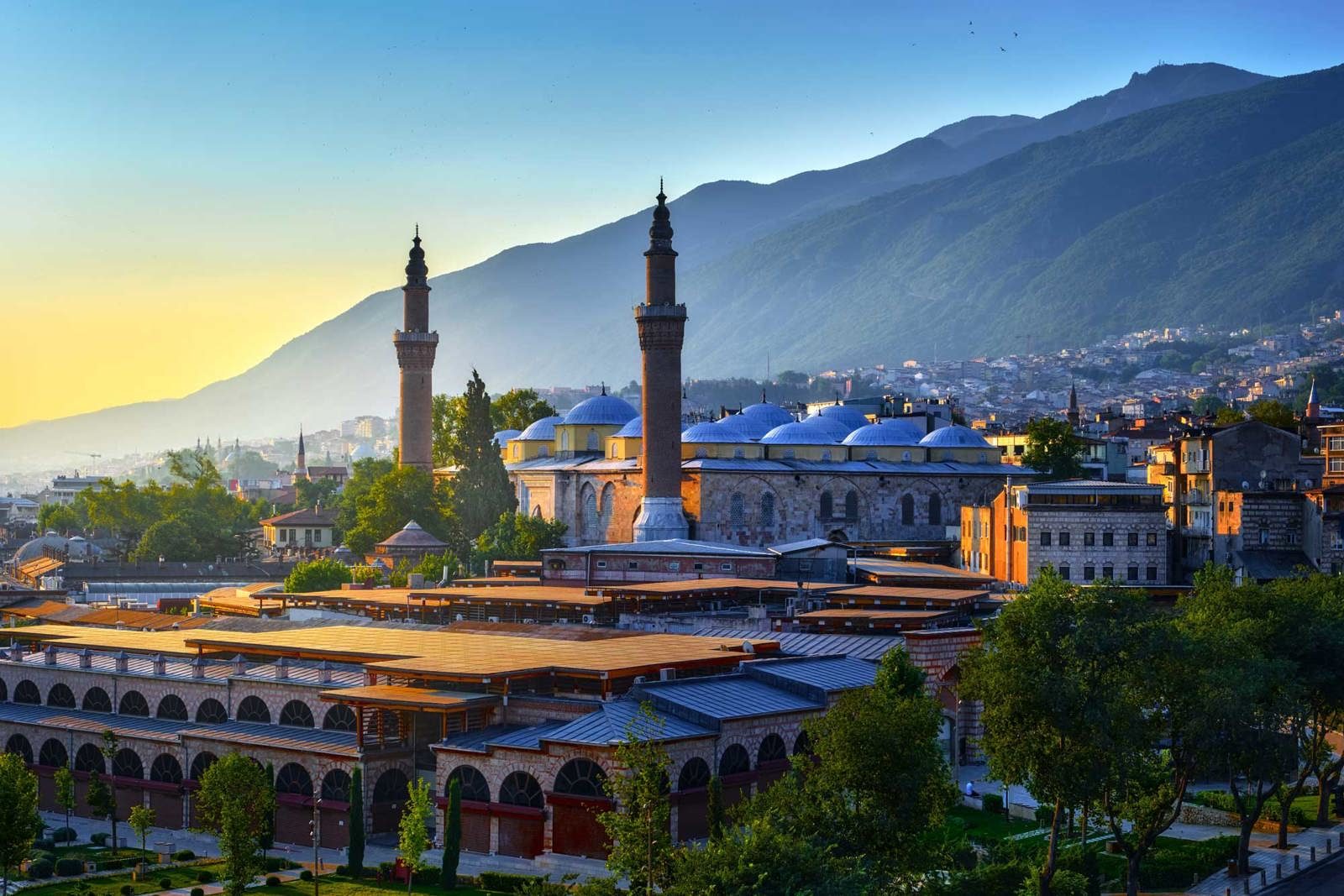
Bursa was the first capital of the Ottoman Empire, and the city still wears that history well. This morning’s tour visits three mosques that span the early Ottoman period. The Ulu Cami (Great Mosque), with its 20 domes and a carved interior fountain, was completed in 1399 and remains one of the most important mosques in Turkey. The Yeşil Cami (Green Mosque) takes its name from the turquoise-green tiles that cover its interior, while the Muradiye Mosque complex contains the tombs of early Ottoman sultans, set in a peaceful garden of cypress trees.
We continue to Bursa’s Koza Han, the old silk bazaar, built in 1491 and still trading in silk and textiles today. The courtyard, with its central fountain and plane trees, is a good spot to sit and take in the atmosphere before we leave. From Bursa we return to Istanbul by road.
StayElite World Istanbul Taksim Hotel (or similar 4-star)MealsBreakfast - Day14
Istanbul’s great landmarks, with a rooftop dinner to finish+
Our final full day is dedicated to the landmarks of Sultanahmet, the historic heart of Istanbul. We begin at the Hagia Sophia Grand Mosque, built as a cathedral in 537 AD under Emperor Justinian and for nearly 1,000 years the largest enclosed space in the world. Converted to a mosque after the Ottoman conquest in 1453, it became a museum in 1934-35 and returned to use as a mosque in 2020. The Byzantine mosaics in the upper gallery are accessible to visitors.
Next door, the Sultan Ahmed Mosque, better known as the Blue Mosque for its blue-tiled interior, faces the Hagia Sophia across a garden. Nearby, the ancient Hippodrome once held chariot races for up to 100,000 spectators. We visit the Basilica Cistern, the vast underground water reservoir built by Justinian, supported by 336 marble columns, then walk through the Grand Bazaar, one of the world’s oldest and largest covered markets.
The day ends at Topkapi Palace, the Ottoman administrative centre for nearly four centuries. This evening, dinner is on a rooftop terrace as the minarets and domes of the old city darken against the sky and the lights gleam along the Bosphorus.
StayElite World Istanbul Taksim Hotel (or similar 4-star)MealsBreakfast, Dinner - Day15
Tour ends in Istanbul+
Our tour ends this morning after breakfast.
MealsBreakfast
Accommodation
Where you stay
Elite World Istanbul Taksim
Kolin Hotel
Elite World Kusadasi
Adempira Termal and Spa Hotel
Novotel Konya
Hanedan Cappadocia Suites
Radisson Blu Hotel
Mövenpick Bursa
Elite World Istanbul Taksim Hotel
Hotels are as planned; occasionally similar alternatives are used.
Peace of mind
What's included
- ✦14 nights’ accommodation
- ✦Meals Included: breakfast daily, 2 lunches and 12 dinners
- ✦Itinerary as described
- ✦Services of guides and local representative
- ✦Interested in adding flights to this tour?
- ✦Find out more
- ✦.
- ✦- Travel Guide -
- ✦You can find out more about the country on the travel guide.
- ✦Flights from the UK can be added — ask your adviser